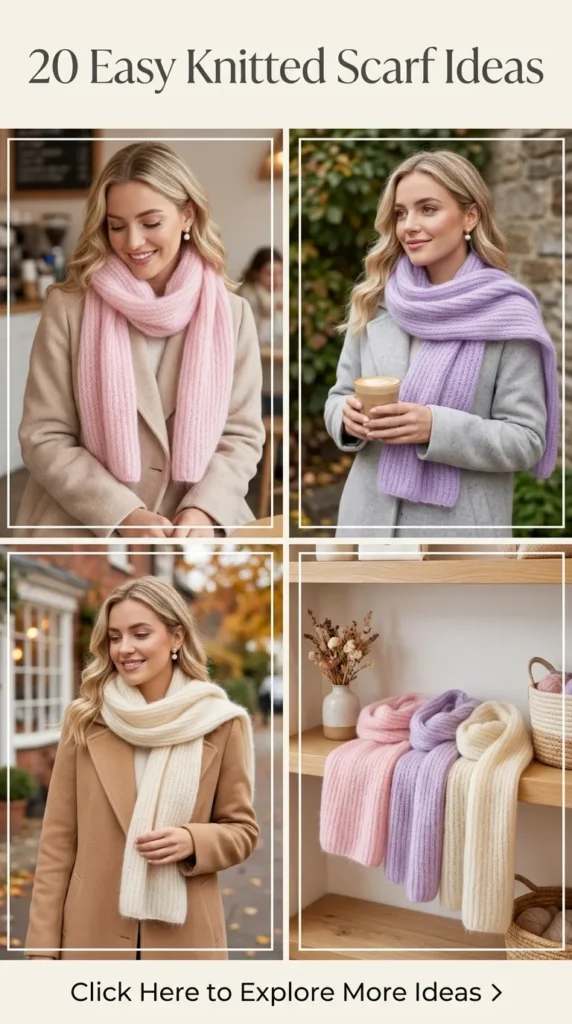
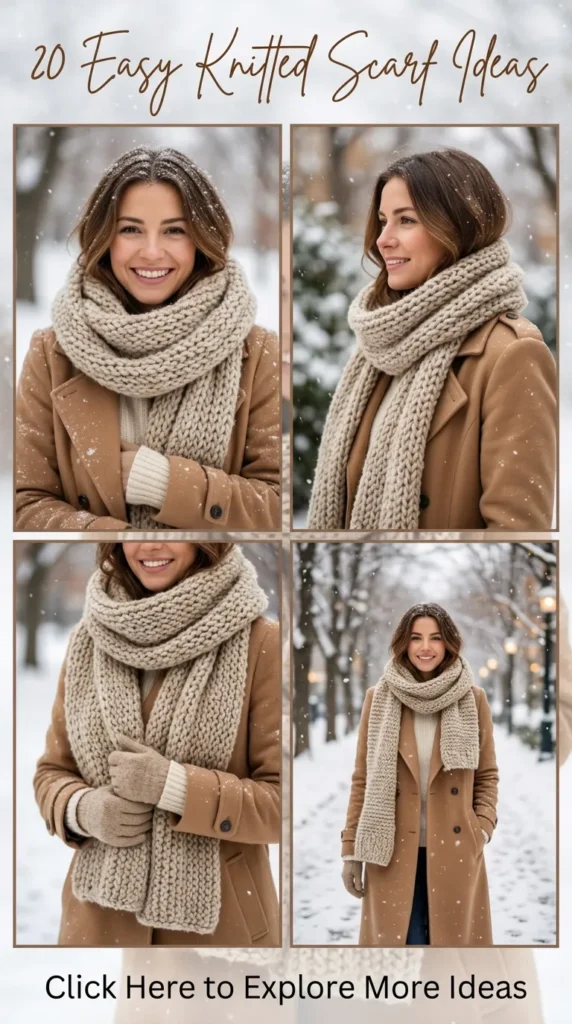
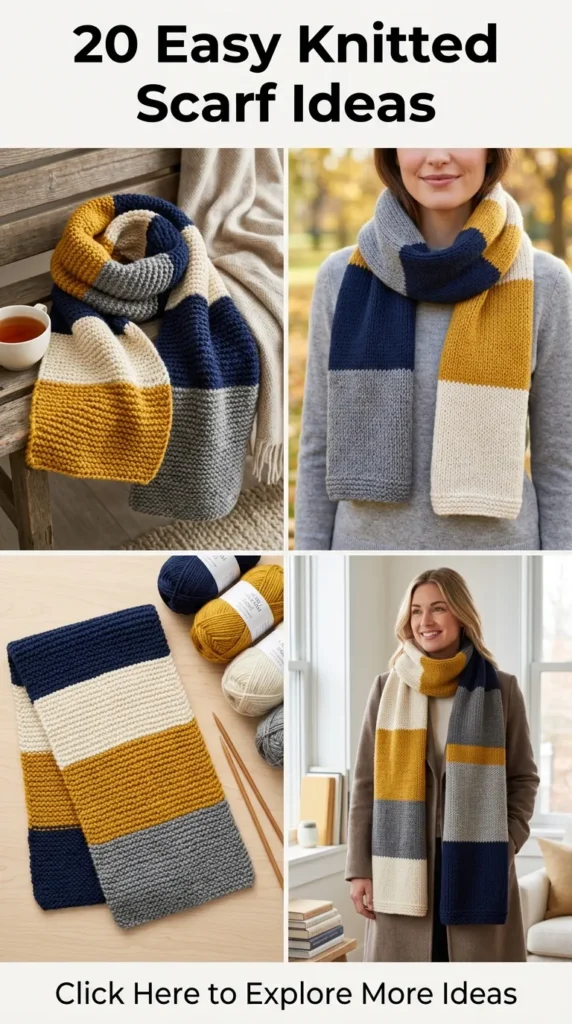
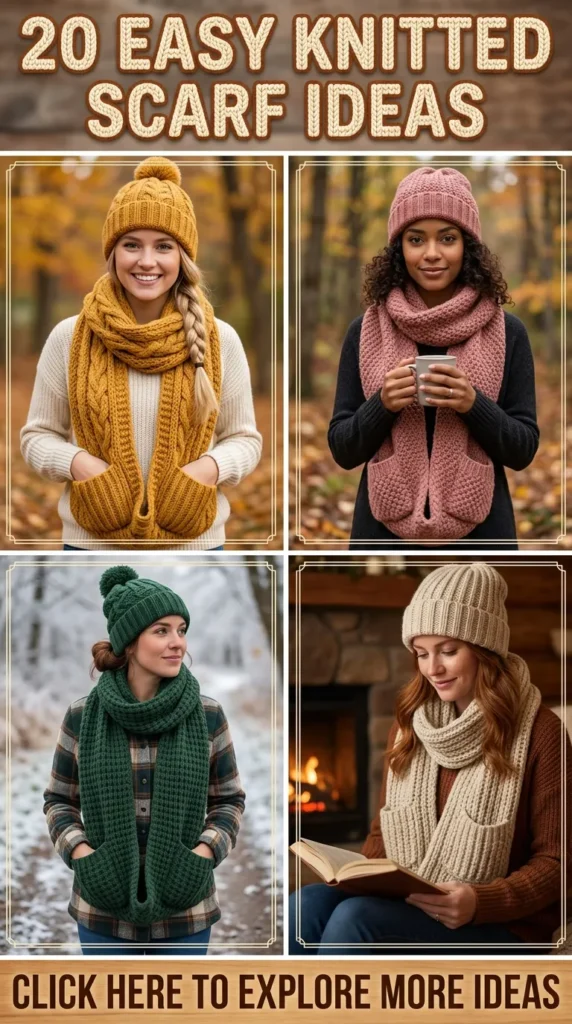
Handcrafted knitwear embodies slow fashion, mindful living, and effortless personal style. A hand-knitted scarf is one of the most rewarding accessories to create: it requires zero complex garment shaping, acts as a canvas for texture and color, and transforms a simple outfit into a curated aesthetic look.
1. The Cloud-Soft Chunky Fisherman Rib Scarf
Introduction
A dramatic, oversized winter staple that focuses on vertical, puffy ribs. It mimics the cozy aesthetic of contemporary Nordic knitwear while remaining deeply grounded in heritage stitching.
What This Idea Means
This scarf is about structural presence, tactile luxury, and cold-weather insulation. The half-fisherman or full-fisherman rib stitch creates deep valleys and plump ridges that trap body heat efficiently.
How to Make It
- Yarn & Needles: Super bulky weight wool or alpaca blend with 10 mm (US 15) straight or circular knitting needles.
- Cast On: Cast on an odd number of stitches (e.g., 21 to 25 stitches for an 8-inch width).
- Base Pattern: Set up row with standard
[K1, P1]. Follow with pattern rows workingK1b(knit one below into the stitch of the row beneath) followed byP1. - Length: Work until the scarf measures between 75 and 85 inches, then bind off loosely in rib pattern.
Tips and Variations
- Use wooden needles to keep slippery, chunky wool secure.
- For a modern aesthetic, knit this in an un-dyed cream, heather gray, or deep espresso brown.
2. The Raw-Edge Garter Stitch Blanket Scarf
Introduction
The quintessential beginner-friendly project that looks like an artisan boutique piece. It relies solely on the knit stitch worked flat over a generous width.
What This Idea Means
A celebration of minimalist simplicity. It proves that complex stitch patterns are unnecessary when yarn quality, scale, and clean execution take center stage.
How to Make It
- Yarn & Needles: 4 to 5 skeins of aran or light-bulky wool using 8 mm (US 11) needles.
- Cast On: Cast on 60 to 70 stitches to create a generous width of roughly 16 to 18 inches.
- Pattern: Knit every stitch across every row. Slip the first stitch of every row purlwise with yarn in front to create a crisp, clean cord edge.
- Finishing: Knit until you reach roughly 80 inches. Bind off loosely and wet-block thoroughly.
Tips and Variations
- Add a 7-inch matching twisted fringe along the short edges for a bohemian touch.
- Work with two strands of fingering-weight yarn held together for a subtly mottled color melt.
3. The Modern Honeycomb Textured Wrap
Introduction
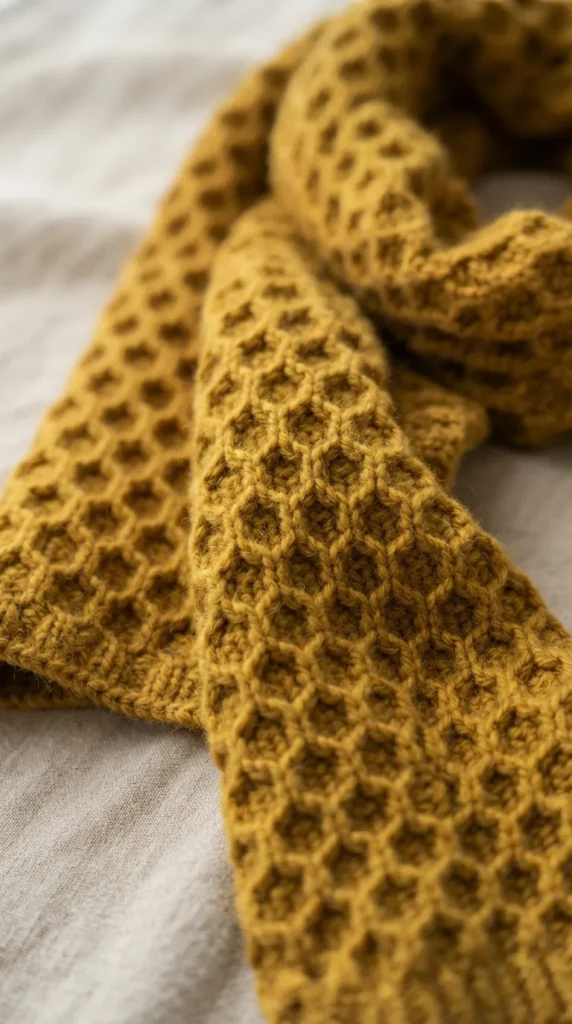
A tactile, dense scarf featuring an all-over honeycomb or waffle slip-stitch texture that mimics woven artisan textiles.
What This Idea Means
It bridges the gap between cozy winter accessories and sleek architectural fashion, providing a rich, three-dimensional surface without intricate cabling needles.
How to Make It
- Yarn & Needles: Worsted weight merino wool with 5.5 mm (US 9) needles.
- Cast On: Multiple of 2 stitches plus edge stitches (e.g., 42 stitches).
- Pattern: Utilize a 4-row repeat based on slip stitches and knit-one-below techniques to create nested hexagonal relief across the fabric.
- Finishing: Bind off in pattern and steam gently to settle the texture without flattening the relief.
Tips and Variations
- Keep yarn tension relaxed; slip stitches pull the fabric narrower than standard stockinette.
- Earth tones like mustard, burnt terracotta, and olive drab enhance the cellular depth of the stitch.

4. The Featherlight Mohair Air Scarf
Introduction
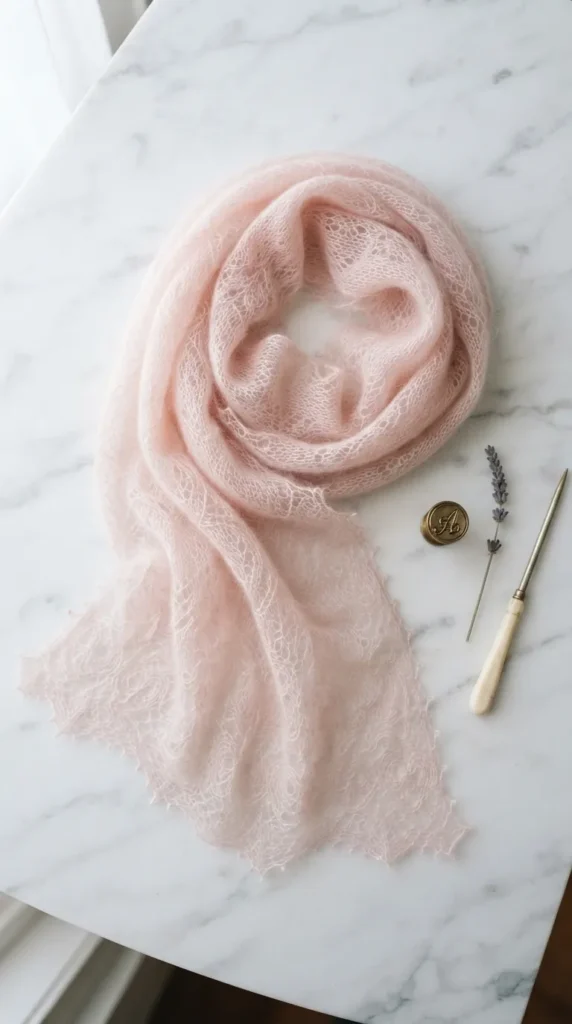
An ethereal, cloud-like accessory worked with lace-weight silk mohair on oversized needles.
What This Idea Means
This design captures a dreamy, delicate Parisian aesthetic. It yields an airy, transparent weave that drapes softly around the neck without weight or bulk.
How to Make It
- Yarn & Needles: 2 balls of lace-weight silk-mohair blend paired with 6.5 mm (US 10.5) needles.
- Cast On: 35 stitches loosely.
- Pattern: Work in continuous garter stitch or simple
[K2, P2]ribbing. Keep your hands relaxed so the long mohair halo fills the spaces between large stitches. - Length: Work 70 inches, bind off with ultra-loose tension, and weave in ends invisibly.
Tips and Variations
- Double up the yarn strand for a slightly denser, marled look.
- Style folded diagonally as a neckerchief or draped loosely over tailored coats.

5. The Neutral Color-Blocked Skinny Scarf
Introduction
A sleek, 90s-inspired skinny scarf constructed using bold blocks of tonal neutrals.
What This Idea Means
A chic styling piece that functions like jewelry. The narrow profile makes it wearable indoors and across seasonal transitions.
How to Make It
- Yarn & Needles: DK weight yarn in 3 complementary tones (e.g., camel, ivory, slate gray) on 4 mm (US 6) needles.
- Cast On: 22 stitches.
- Pattern: Knit in
1x1twisted rib ([K1tbl, P1]) for crisp edge stability. Knit 25 inches in Color A, 25 inches in Color B, and 25 inches in Color C. - Finishing: Weave in color transitions cleanly along the inner stitch ridges.
Tips and Variations
- Make both ends tapered by working symmetric decreases across the final 10 rows.
- Pair with minimalist trench coats, blazers, or crisp poplin shirts.
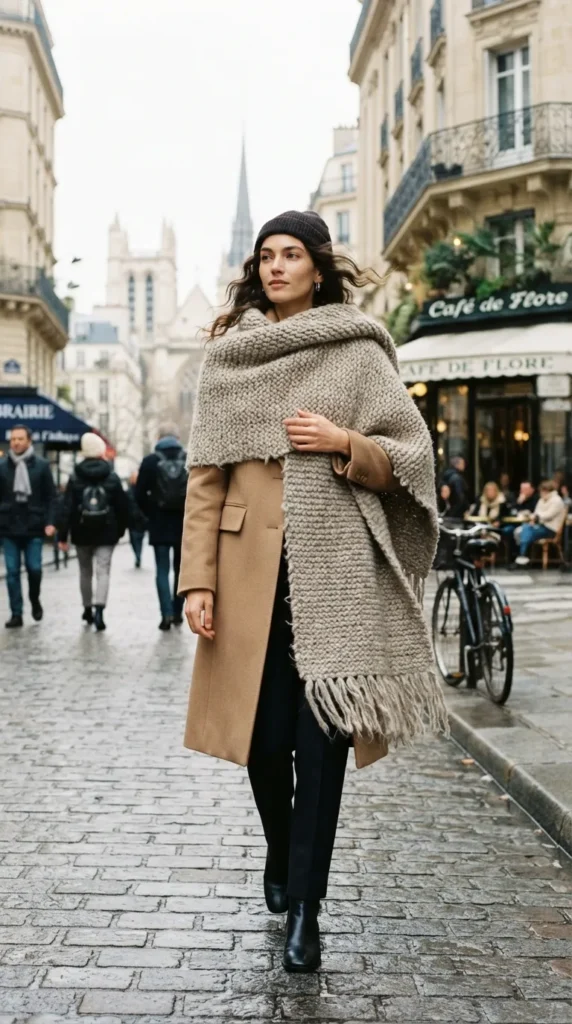
6. The Classic Moss Stitch Heritage Scarf
Introduction
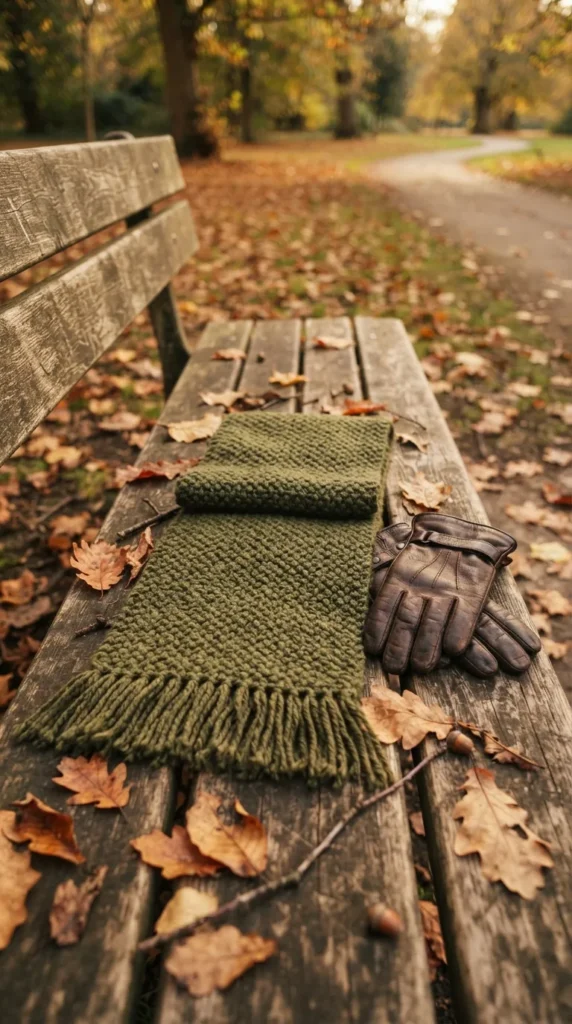
A timeless textured piece alternating knits and purls in a checkerboard sequence that lies flat naturally.
What This Idea Means
Moss stitch (or seed stitch) delivers structured, non-curling edges and an organic, pebble-like surface reminiscent of classic British countryside apparel.
How to Make It
- Yarn & Needles: Worsted weight tweed wool with subtle flecks on 5 mm (US 8) needles.
- Cast On: An even number of stitches (e.g., 36 stitches).
- Pattern (Irish Moss):
- Rows 1 & 2:
[K1, P1]to end. - Rows 3 & 4:
[P1, K1]to end.
- Rows 1 & 2:
- Finishing: Repeat this 4-row sequence until the desired length is reached, then cast off in pattern.
Tips and Variations
- Tweed and heathered yarns emphasize the rustic texture.
- Add deep 3-inch ribbed borders at each end for extra tailoring.
7. The Reversible Shadow Cable Scarf
Introduction
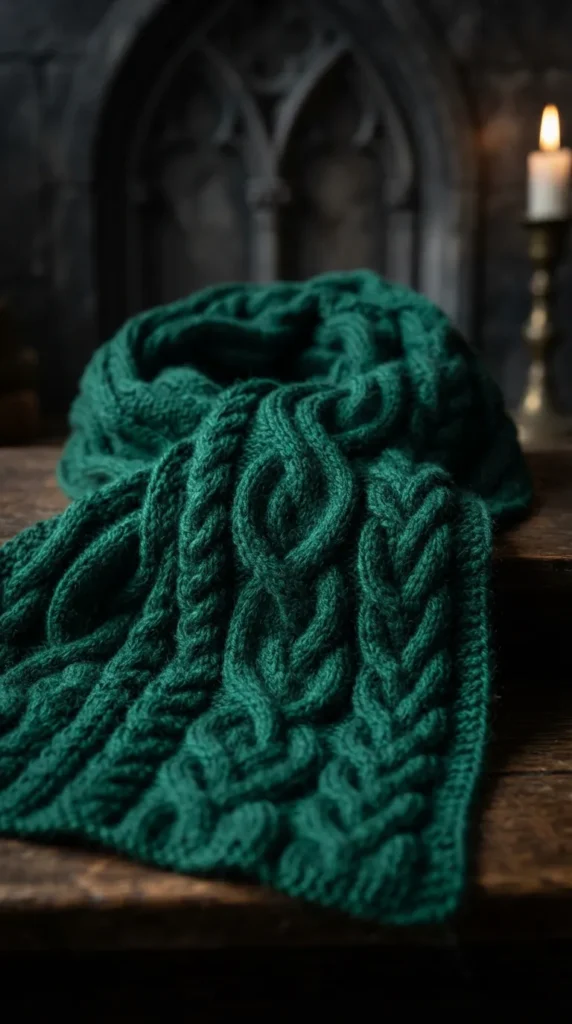
A textured cable scarf that looks identical on both sides by embedding structural cable crosses directly inside a ribbed foundation.
What This Idea Means
Solving the traditional “wrong side” issue of cable knitting, this scarf delivers high elegance regardless of how it is wrapped or flipped.
How to Make It
- Yarn & Needles: Aran-weight merino wool with 5.5 mm (US 9) needles and a cable needle.
- Cast On: 48 stitches.
- Pattern: Set up an all-over
2x2ribbing base. Every 8th row, perform cable crossings over the knit columns using the cable needle while maintaining the[K2, P2]rhythm inside the cable twist. - Finishing: Wet block thoroughly to open up the ribbed cable valleys.
Tips and Variations
- Use high-twist yarn to make the cables pop crisply.
- Perfect in deep jewel tones like emerald green, midnight blue, or rich burgundy.
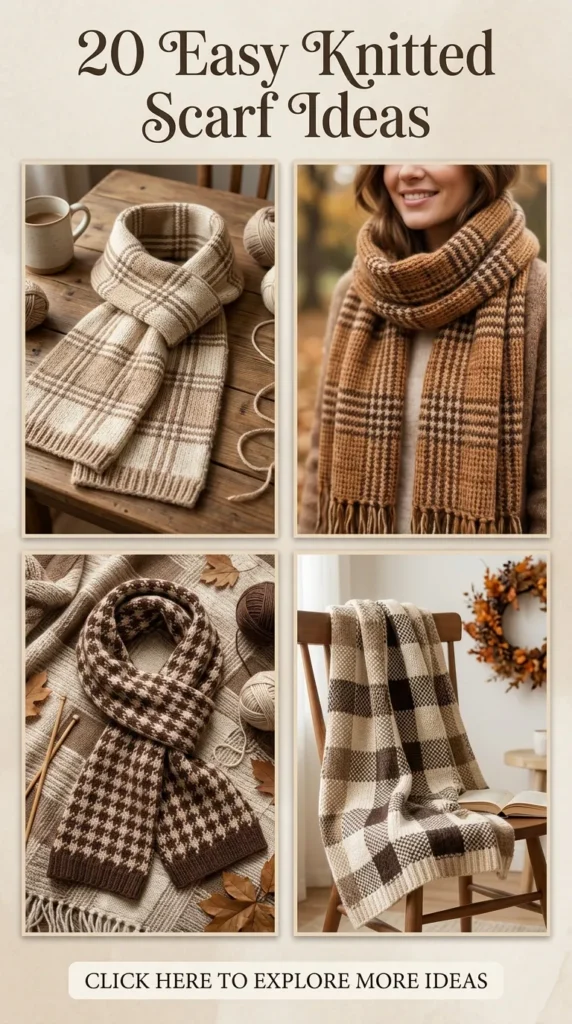
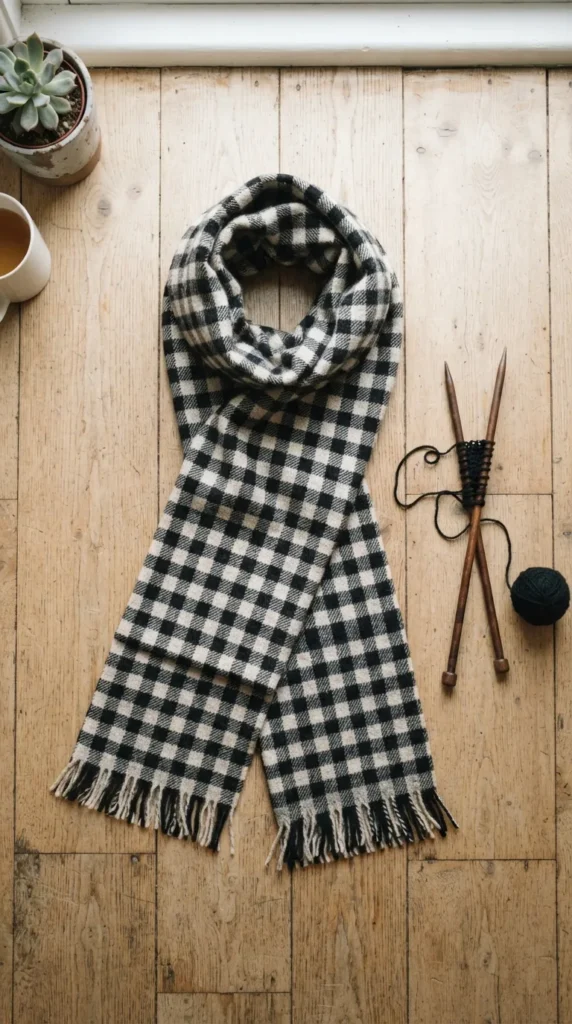
8. The Scandinavian Gingham Check Scarf
Introduction
A graphic, cottagecore-inspired scarf utilizing simple stranded colorwork to create a two-tone gingham pattern.
What This Idea Means
It brings a playful, geometric look to winter wardrobes, marrying traditional Nordic fair isle technique with modern pattern scales.
How to Make It
- Yarn & Needles: Sport or DK weight wool in two high-contrast shades on 4 mm (US 6) needles.
- Cast On: 50 stitches.
- Pattern: Work flat or in the round as a seamless tube (to hide all yarn floats inside). Alternate 4-stitch by 4-row color blocks to produce a crisp checkered grid.
- Finishing: If worked flat, line with a soft fleece backer; if worked as a tube, graft both ends closed with mattress stitch.
Tips and Variations
- Black and cream, or soft sage and ecru, offer classic color palettes.
- Adding chunky monochrome pom-poms at the corners adds personality.
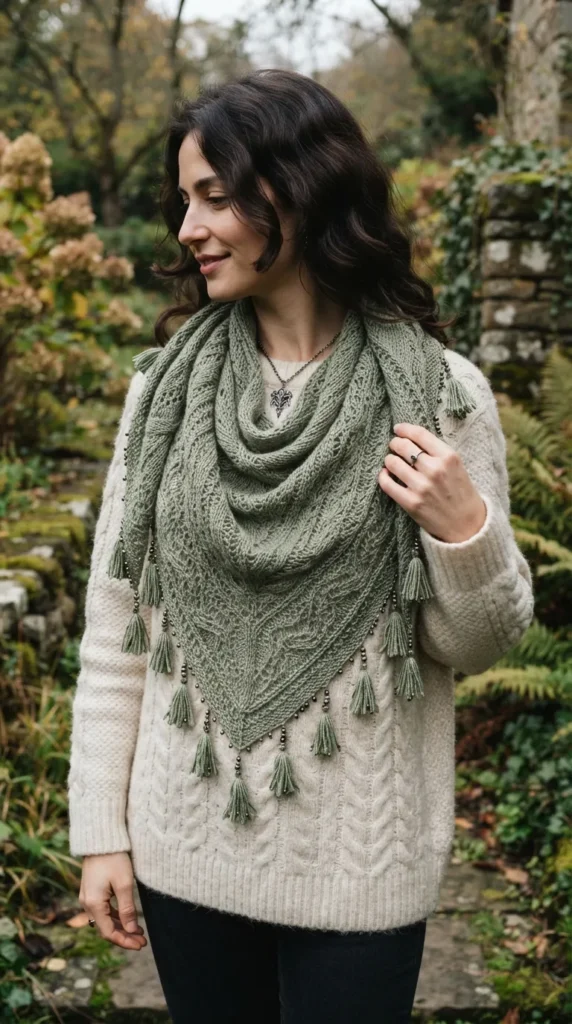
9. The Asymmetrical Triangle Shawl-Scarf
Introduction
A modern bandana-style triangular scarf that grows diagonally from a single point using simple increases.
What This Idea Means
Casual, effortless, and easy to style. The triangular shape reduces bulk behind the neck while providing ample drape over the chest.
How to Make It
- Yarn & Needles: 2 skeins of fingering or sport weight yarn on 4.5 mm (US 7) circular needles (for holding growing stitch counts).
- Cast On: 3 stitches.
- Pattern: Knit every row (garter stitch). Increase 1 stitch at the beginning of every right-side row using a yarn over or
KFB(knit front and back), maintaining a straight edge along one side. - Finishing: Knit until yarn is nearly spent, then perform an elastic bind-off.
Tips and Variations
- Incorporate eyelet lace rows every 10 rows for visual variety.
- Attach three small tassels to the corners for a finished artisanal drape.
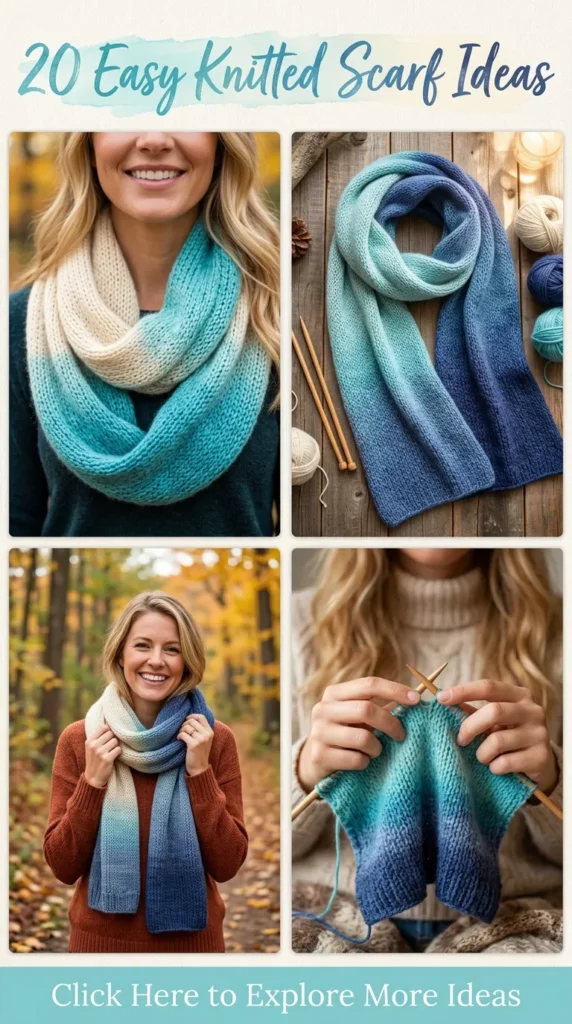
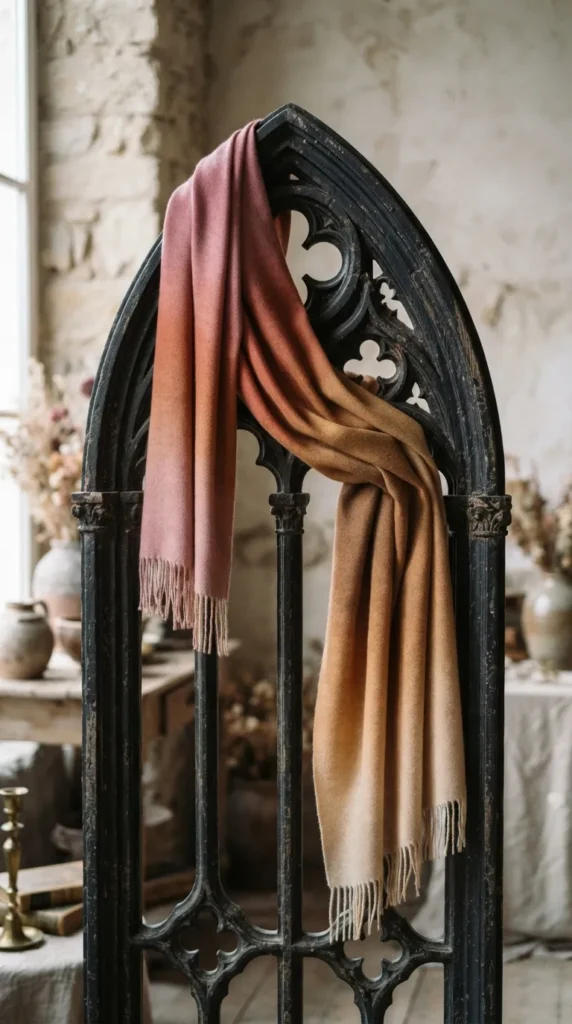
10. The Gradient Sunset Ombré Scarf
Introduction
A long, flowing wrap featuring subtle, blended color transitions shifting from one soft shade to another.
What This Idea Means
A meditative knitting experience focused on gentle color transitions, evoking evening skies and painted canvases.
How to Make It
- Yarn & Needles: 4 shades of fingering-weight yarn held double throughout, paired with 6 mm (US 10) needles.
- Cast On: 40 stitches.
- Pattern: Start with 2 strands of Color A. Transition to 1 strand of Color A + 1 strand of Color B, then 2 strands of Color B, and continue sequentially.
- Finishing: Maintain garter stitch throughout to let the marled color shifts remain the focal point.
Tips and Variations
- Choose adjacent palette families, such as blush pink, terracotta, warm ochre, and sand.
- Keep gauge loose to ensure a fluid, cascading drape.
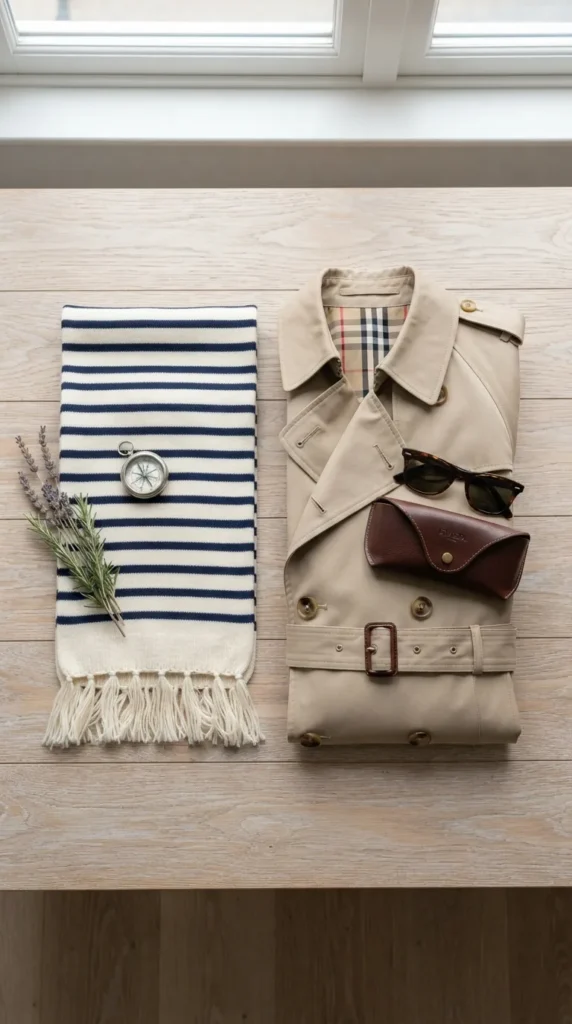
11. The French Riviera Breton Stripe Scarf
Introduction
A clean, nautical-inspired striped scarf that brings timeless summer tailoring into wool accessories.
What This Idea Means
A study in proportion and minimalism. Crisp navy-and-cream striping matches instantly with overcoats, leather jackets, and denim.
How to Make It
- Yarn & Needles: DK weight superwash merino with 4 mm (US 6) needles.
- Cast On: 44 stitches.
- Pattern: Knit in
1x1rib or garter stitch. Alternate 14 rows of cream yarn with 4 rows of deep navy yarn throughout. - Edge Work: Carry the non-working yarn neatly up the side selvage inside a 2-stitch slipped-stitch edge.
Tips and Variations
- Reverse the scheme to a dark charcoal base with thin ivory pinstripes.
- Maintain sharp stripe transitions by changing yarn colors on the right side.
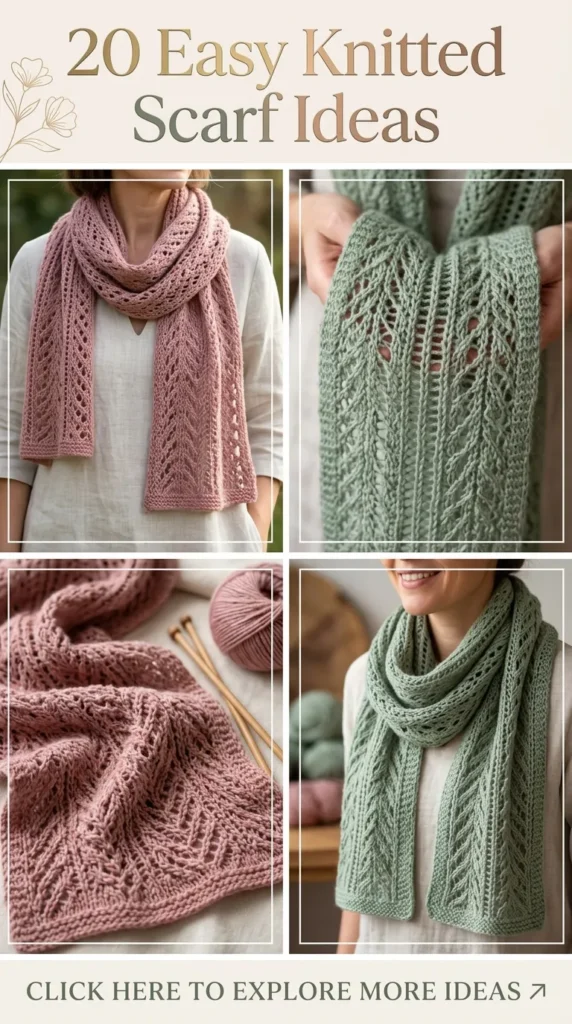
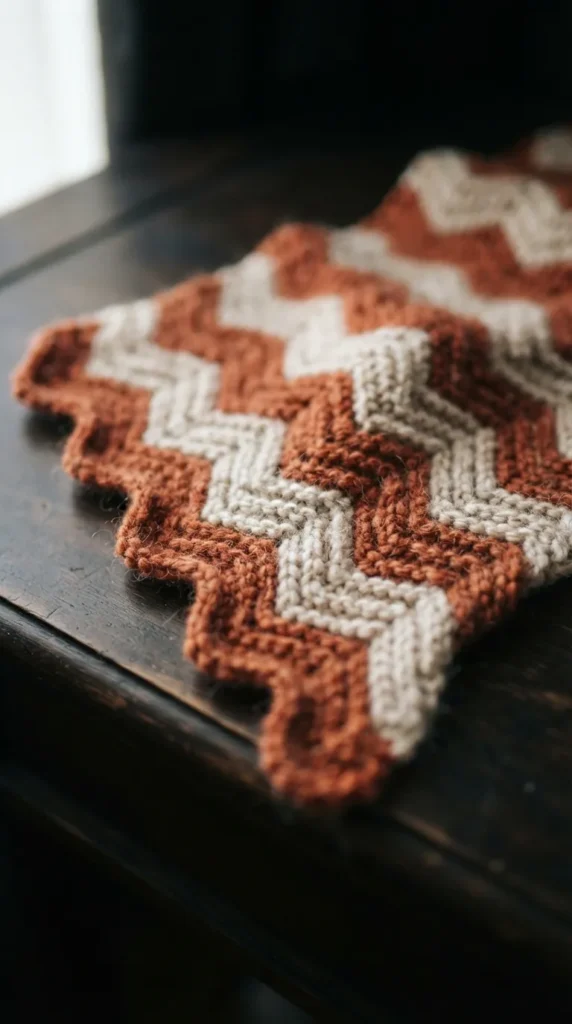
12. The Wavy Chevron Ripple Scarf
Introduction
A dynamic geometric scarf shaped through simple pairing of increases and decreases that form rhythmic zigzag edges.
What This Idea Means
It creates organic movement and scalloped bottom edges naturally without requiring secondary edge construction.
How to Make It
- Yarn & Needles: Worsted weight yarn on 5 mm (US 8) needles.
- Cast On: Multiple of 14 stitches plus 2 edge stitches.
- Pattern:
- Row 1:
K1,*K1, k2tog, K4, yo, K1, yo, K4, ssk, K1*, repeat to last stitch,K1. - Row 2: Purl all stitches (or knit for a garter ripple).
- Row 1:
- Finishing: Repeat until desired length; the cast-on and bind-off edges will form peaks and valleys naturally.
Tips and Variations
- Alternate yarn colors every 6 to 8 rows to accent the zigzag ridges.
- Block firmly with pins along each peak to accentuate sharp geometric angles.
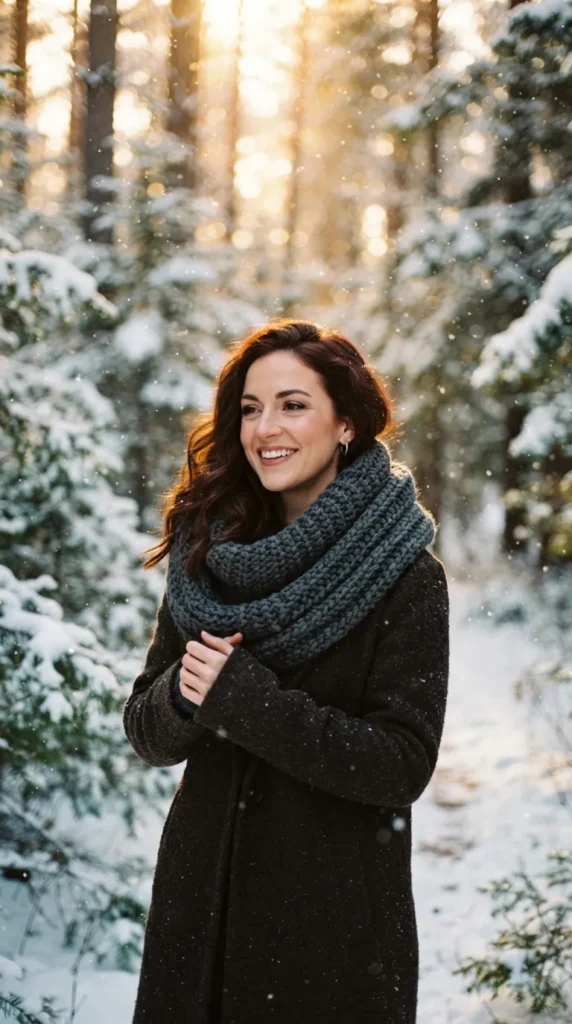
13. The Cozy Tube Infinity Cowl
Introduction
A circular, double-thick cowl knitted seamlessly in the round as a long continuous tube and grafted end-to-end.
What This Idea Means
A functional design with zero raw edges and no visible “wrong side.” It stays warm, windproof, and perfectly positioned around the neck.
How to Make It
- Yarn & Needles: Sport or light DK weight yarn with a 40 cm (16-inch) circular needle in size 3.75 mm (US 5).
- Cast On: 80 stitches; join to work in the round without twisting.
- Pattern: Knit every round in plain stockinette stitch until the tube measures 30 inches.
- Finishing: Twist the tube once (for a mobius drape) or leave straight, then graft cast-on and bind-off ends together using Kitchener stitch.
Tips and Variations
- Work wide blocks of contrasting pastels or earth tones across the tube length.
- The interior hides all yarn ends effortlessly, cutting finishing time in half.
14. The Bouclé Cloud Scarf
Introduction
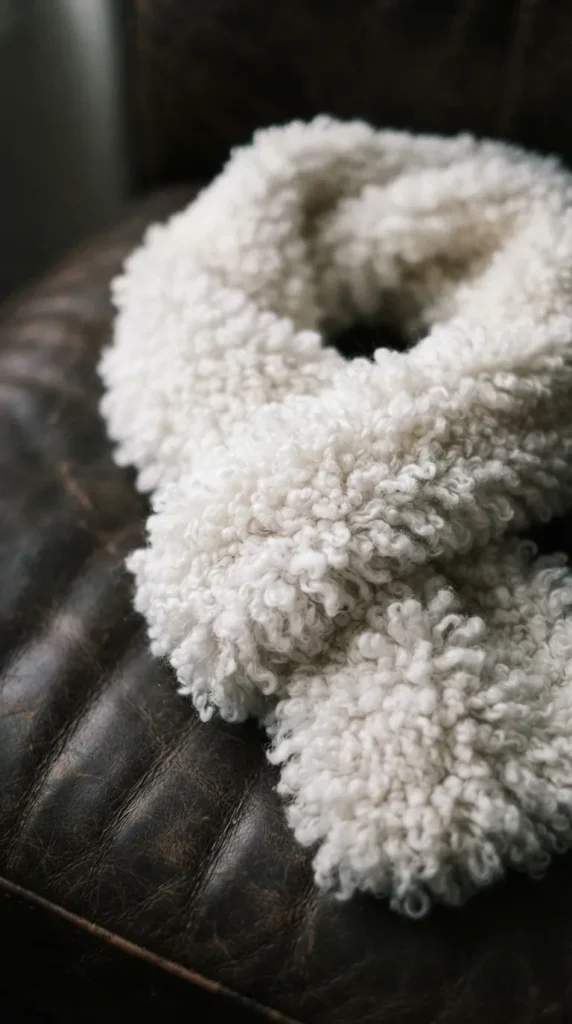
A minimalist project relying entirely on textured bouclé or looped teddy yarn for visual richness.
What This Idea Means
Tactile softness meets modern minimalism. The looped texture hides individual stitches, turning basic knitting into a shearling-like fabric.
How to Make It
- Yarn & Needles: Chunky alpaca/wool bouclé yarn paired with 8 mm (US 11) needles.
- Cast On: 24 stitches loosely.
- Pattern: Work in straight garter stitch throughout. Count stitches periodically since loop yarn can obscure stitch visibility.
- Finishing: Bind off loosely when length reaches approximately 72 inches.
Tips and Variations
- Choose smooth, polished wooden or metal needles so the loops do not snag.
- Style with smooth tailored wool coats for a striking high-contrast texture play.


15. The Minimalist Drop-Stitch Scarf
Introduction
An airy scarf featuring horizontal bands of elongated, ladder-like open stitches framed by crisp garter sections.
What This Idea Means
It provides warm-weather versatility, high visual interest, and fast project completion, as elongated dropped stitches build fabric rapidly.
How to Make It
- Yarn & Needles: Linen or cotton/silk blend yarn on 4.5 mm (US 7) needles.
- Cast On: 30 stitches.
- Pattern: Knit 8 rows of garter stitch. On the drop-stitch row:
*K1, wrap yarn twice around the needle*. On the next row: knit all stitches while letting the extra yarn wraps drop off the needle to create long vertical bars. - Finishing: Repeat this sequence, then bind off and gently pull fabric vertically to balance stitch length.
Tips and Variations
- Excellent for transitioning into spring and cool summer evenings.
- Use smooth plant-based fibers to keep the dropped ladders distinct and crisp.
16. The Diagonal Bias Garter Ribbon
Introduction
A diagonal-knit scarf featuring clean slanted ends, worked by increasing at the right edge while decreasing at the left edge on alternating rows.
What This Idea Means
Bias knitting produces an elastic, flowing drape that sits flat without curling and hangs with clean angled points.
How to Make It
- Yarn & Needles: Fingering or DK weight yarn with 4 mm (US 6) needles.
- Cast On: 35 stitches.
- Pattern:
- Row 1 (Right Side):
KFB, knit to last 2 stitches,k2tog. - Row 2 (Wrong Side): Knit all stitches.
- Row 1 (Right Side):
- Finishing: Repeat these two rows until you reach 70 inches. Bind off loosely.
Tips and Variations
- Self-striping or gradient yarn naturally produces striking diagonal chevron bands.
- Block firmly into a crisp parallelogram.
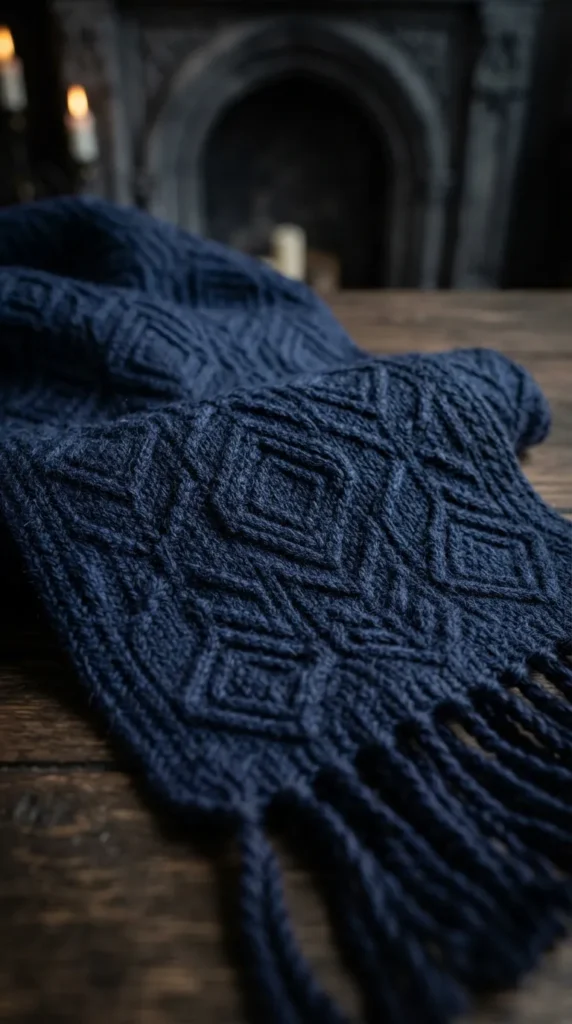
17. The Diamond Brocade Relief Scarf
Introduction
A sophisticated textured scarf using alternating knit and purl patterns to render raised diamond geometries across the surface.
What This Idea Means
Understated luxury. It gives the appearance of intricate weaving or quilting while using only fundamental stitches.
How to Make It
- Yarn & Needles: Crisp worsted weight wool with high stitch definition on 4.5 mm (US 7) needles.
- Cast On: Multiple of 8 stitches plus 2 edge stitches (e.g., 42 stitches).
- Pattern: Follow an 8-row diamond brocade grid chart based on expanding and contracting purl stitches against a stockinette field.
- Edge Finish: Add a 3-stitch garter border on both sides to prevent lateral edge curl.
Tips and Variations
- Solid, non-fuzzy yarns in cream, sage, or navy show the geometric pattern best.
- Steam block lightly to enhance pattern clarity without crushing stitch height.
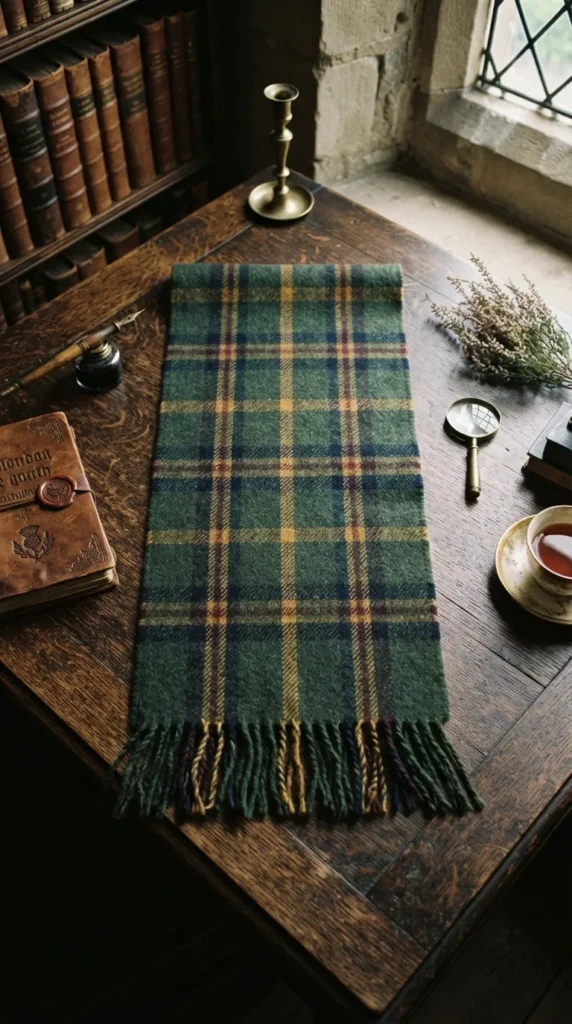
18. The Heritage Fringe Tartan Scarf
Introduction
A faux-woven plaid scarf where horizontal knitted stripes are crossed by vertical stripes woven in using a tapestry needle.
What This Idea Means
Combines knitting and simple weaving to create authentic multi-color tartan patterns without managing multi-strand intarsia.
How to Make It
- Yarn & Needles: DK weight wool in 3 colors (e.g., forest green, navy, mustard) on 4.5 mm (US 7) needles.
- Base Pattern: Knit horizontal color stripes in a mesh-like sequence of
[K1, yo, k2tog]to leave open eyelet vertical columns. - Weaving: Thread lengths of yarn through a tapestry needle and weave vertically up through the eyelet columns in complementary shades.
- Finishing: Knot the warp and weft yarn ends together along both short edges to form fringe tassels.
Tips and Variations
- Use an odd number of vertical columns for symmetric grid layouts.
- Keep vertical weaving tension loose to match the knitted fabric’s natural stretch.
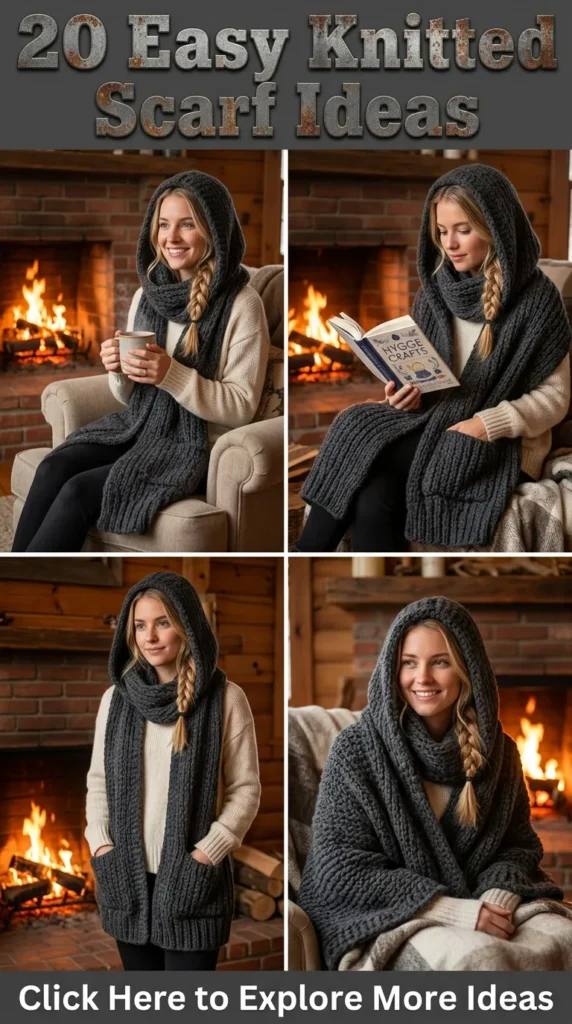
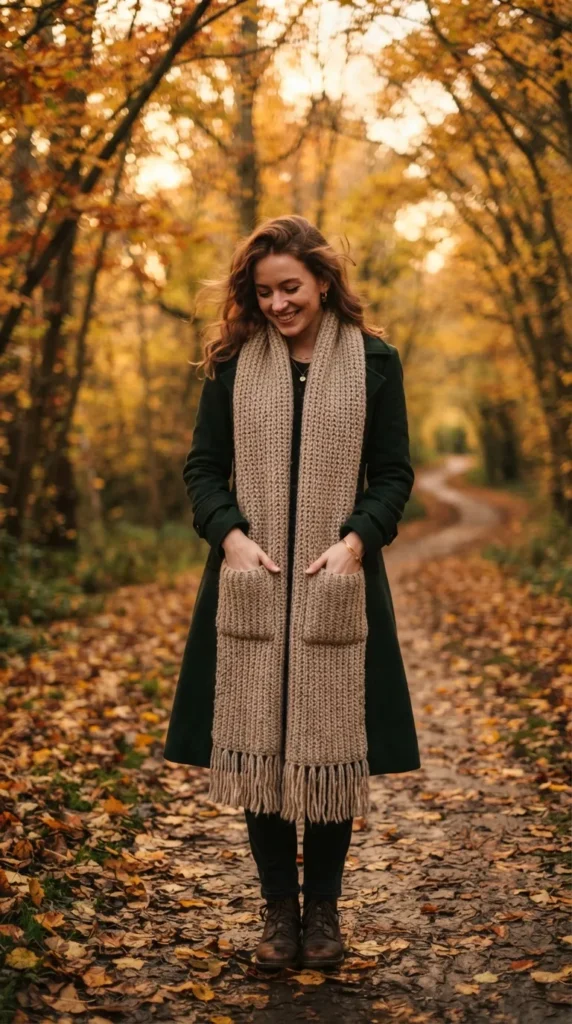
19. The Fluffy Brioche Pocket Scarf
Introduction
A wide, ultra-plush brioche-stitch scarf with deep knitted pockets added to both ends for carrying essentials and warming hands.
What This Idea Means
The ultimate blend of practical outerwear utility and luxurious, squishy knitwear volume.
How to Make It
- Yarn & Needles: Bulky weight yarn on 6.5 mm (US 10.5) needles.
- Cast On: 32 stitches.
- Pattern: Work in two-color or one-color brioche stitch for 80 inches.
- Pockets: Fold the bottom 8 inches of each end upward and seam the side edges using mattress stitch, or knit separate patch pockets and sew them in place.
- Finishing: Reinforce pocket mouth edges with a row of crochet slip stitches.
Tips and Variations
- Line the interior of the pockets with soft silk or flannel for extra wind protection.
- Accent the pocket borders with decorative tortoiseshell buttons.
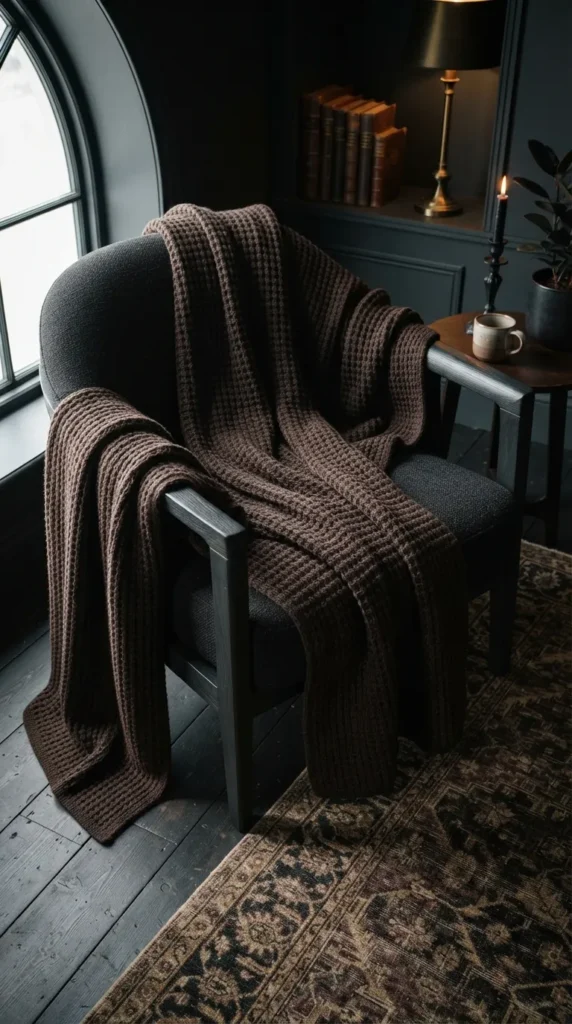
20. The Oversized Waffle Stitch Cozy Wrap
Introduction
A heavy, blanket-style wrap featuring an all-over dimensional waffle texture that locks in warmth and maintains structured edges.
What This Idea Means
Substantial, architectural, and cozy. It drapes naturally over the shoulders as an open-front cape or bundles tightly around the neck.
How to Make It
- Yarn & Needles: Aran weight alpaca-wool blend on 6 mm (US 10) needles.
- Cast On: Multiple of 3 stitches plus 2 (e.g., 56 stitches).
- Pattern:
- Row 1 (Right Side):
*K2, P1*, repeat to last 2 stitches,K2. - Row 2:
*P2, K1*, repeat to last 2 stitches,P2. - Row 3: Knit all stitches.
- Row 4: Purl all stitches.
- Row 1 (Right Side):
- Finishing: Work 75 inches, bind off in pattern, and wet-block thoroughly.
Tips and Variations
- Neutral hues like oat milk, charcoal, and warm camel highlight the waffle depth.
- Wear it pinned with a brass shawl pin for a structured silhouette.